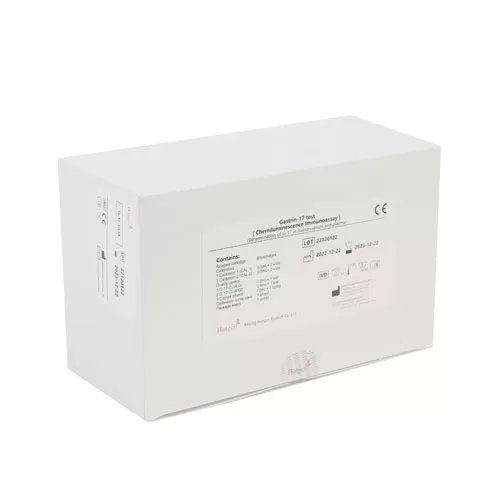
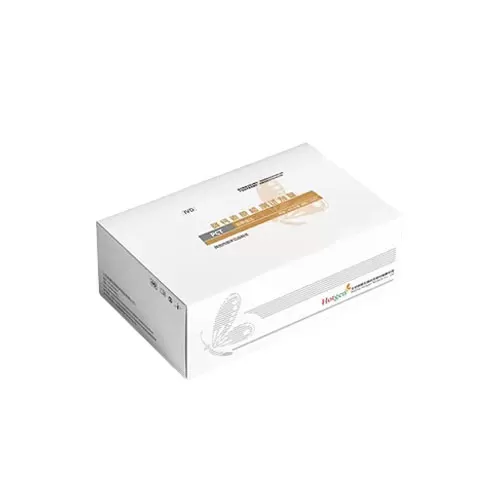
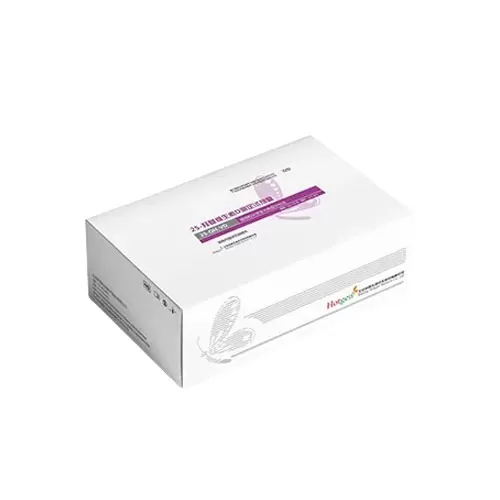
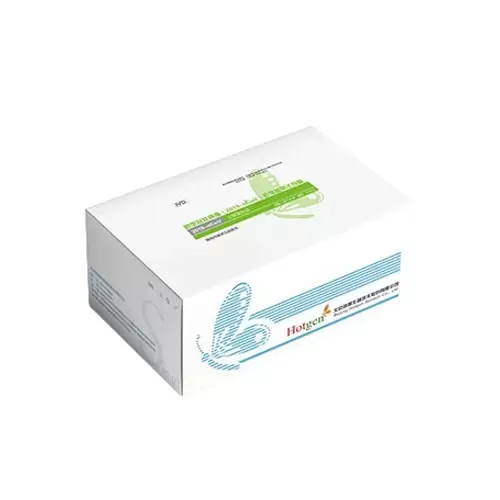
In recent years, up-converting phosphor (UCP)–based detection has emerged as a breakthrough in rapid diagnostics. By using up-converting phosphor technology (UPT), Hotgen delivers highly sensitive, fast, and stable detection across clinical, security, and food safety fields. The UPT kit series leverages the unique optical properties of UCP nanoparticles to overcome limitations of traditional assays—delivering reliable results even in challenging conditions.
What Is UPT Technology — The Science Behind the Sensitivity
At the heart of UPT lies up-converting phosphor (UCP) materials — typically nanometer-scale rare-earth doped particles (lanthanide ions in a suitable crystal lattice) that exhibit photon upconversion: when excited with near-infrared (NIR) light, they emit higher-energy visible light. Importantly, biological samples generally do not autofluoresce under NIR excitation, so UCP-based assays achieve virtually zero background interference, no photobleaching, and no quenching—common drawbacks with conventional fluorescent labels.
Because of these properties, UPT enables clear, stable, and reproducible signals, even when detecting low-abundance analytes. The high signal-to-noise ratio inherent to UPT dramatically increases the assay sensitivity compared to standard fluorescence or colorimetric rapid tests.
UPT Kit Use — Fast, Reliable, and Practical in Real-World Scenarios
One of the greatest advantages of a Hotgen UPT kit is that it brings together high-performance detection and ease-of-use. Unlike many high-sensitivity molecular assays, UPT-based tests require minimal pre-treatment, and can often deliver results within 15 minutes to 20 minutes depending on the specific kit and analyte.
Because UCP particles are robust, stable, and unaffected by common interferents (such as hemoglobin or sample autofluorescence), UPT-based kits maintain accuracy and repeatability even with complex biological matrices.
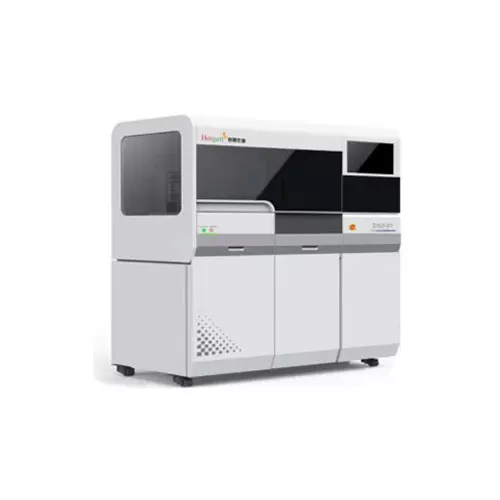
Moreover, UPT kits are compatible with portable analyzers—for example, Hotgen's UPT devices such as the UPT2800 or handheld models. This portability allows wide deployment: in small clinics, remote areas, or even on-site testing (e.g., border control, food inspection, emergency response), where conventional laboratory infrastructure may be unavailable.
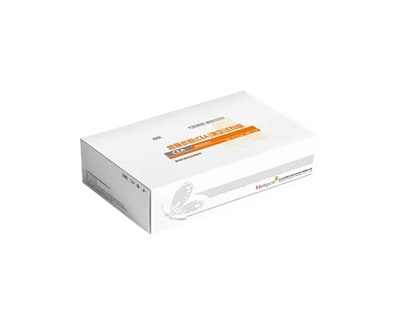
In practice, UPT kit use might look like this: a sample is applied to a lateral-flow strip, after a short incubation the strip is placed into a handheld or desktop UPT reader, which then reads the upconverted luminescence and reports a quantitative or qualitative result. The process is simple, fast, and user-friendly—making it accessible to trained technicians and non-lab personnel alike.
Versatile Applications — From Clinical Diagnostics to Biosecurity and Food Safety
Because of its reliability, sensitivity, and practicality, Hotgen's UPT platform has found application across a wide range of fields:
Clinical diagnostics
Hotgen offers one of the most comprehensive IVD portfolios based on UPT technology, including inflammation markers (e.g., high-sensitivity PCT, CRP, IL-6), cardiac biomarkers (NT-proBNP, cTnI, MYO, CK-MB, H-FABP, Lp-PLA2), thromboembolism markers (D-dimer), liver disease markers (HA, LN, Collagen C IV, pIII-NP, TIMP-1, GP73, AFP), autoimmune markers (anti-CCP), renal injury (NGAL), and even preterm birth prediction markers (fFn).
For example, a UPT-based lateral flow assay for NT-proBNP has demonstrated high sensitivity, reproducibility, and stability, providing a point-of-care solution for diagnosing acute heart failure that correlates well with standard laboratory methods.
Biosecurity and infectious disease / biodefense
UPT's robustness and low background make it especially suitable for high-stakes, on-site pathogen detection or biological threat screening.
In crisis situations or at public events, rapid, reliable detection without lab infrastructure can make all the difference—UPT kits meet that need.
Food safety and environmental monitoring
The sensitivity and specificity of UPT kits also empower food safety applications—identifying foodborne pathogens, mycotoxins. This makes UPT kits valuable tools for regulatory agencies, food producers, and inspection bodies aiming to safeguard public health.
Why Hotgen's UPT Kits Are Leading the Field
Hotgen stands out in the IVD and diagnostics industry through its mastery of UPT core technology, backed by dozens of domestic and international patents, and successful real-world deployment.
Their UPT platform offers a rare combination of features:
High sensitivity & specificity — detection limits suitable for low-abundance biomarkers or pathogens.
Rapid turnaround time — often within 15–20 minutes, making them ideal for point-of-care or emergency settings.
No background interference, high photostability — thanks to UCP materials, improving accuracy and reproducibility.
Ease of use & portability — minimal pre-treatment, simple protocol, and compatibility with handheld or desktop readers.
Wide application range — from human clinical diagnostics to biosecurity detection and food safety monitoring.
As such, Hotgen's UPT kits embody a next-generation diagnostic platform that bridges cutting-edge nanotechnology and real-world usability.
 English
 français
 Deutsch
 Español
 ไทย
ไทย русский
 português
 العربية
 Indonesia